Pool Buoys in the Pond
RMIT University Master of Architecture Graduate Project 2017
Supervisor: Michael Spooner




Dear Pool,
I still remember the first time I noticed you, looming over the edge of the concrete barrier as I crossed the freeway. You managed to be both strange and familiar all at once. If not for the glimpse of blue-green water inside, I would have mistaken you for a car park.
My major project is an attempt to design a public pool and sporting facility in North Melbourne. The site I have chosen for the project is adjacent to the existing North Melbourne Recreation Reserve, linking the Arden Street Oval with the CityLink freeway to the west. The freeway runs above Moonee Ponds Creek, with the immense scale of the freeway towering over the neglected stream.
The creek itself has been drastically altered from its original state and is often highly polluted, collecting all manner of detritus from the surrounding areas.
After extreme rainfall, the entire site is subject to flooding, with the 100-year flood line extending almost back to Arden Street Oval.
My first entry point to the project was a reading of the 1968 film The Swimmer, which follows the main character Ned as he attempts to swim across the county from backyard pool to backyard pool. Two key moments in the film drove the project thematically:
The first is when Ned must cross a busy freeway in nothing but his bathers to continue his journey to the next pool. This intersection between bather and heavy infrastructure is a moment I wanted to explore in my project.
The second is when Ned decides to swim across the Bizwanger’s pool, holding his bathers above his head to keep them dry. This absurd moment conjured the image of an elevated pool over the floodplain. Just as Ned held his bathers above the pool to keep them dry, I wanted to design a pool elevated above a floodplain to keep it from getting wet.
In conjunction with the film, I began to produce a series of magazines titled WET: The Magazine of Gourmet Bathing, inspired by the cult 1970s magazine dedicated to alternative culture. Each issue of WET documented my research and investigations around particular themes of bathing, water, wetness, and swimming.
Each issue reflects my shifting focus and its various ebbs and flows over the weeks.
Along with responding to the existing condition of the site, I also attempted to address the proposed development to the south, with the new Arden Street Metro and associated development forming one edge of my site.
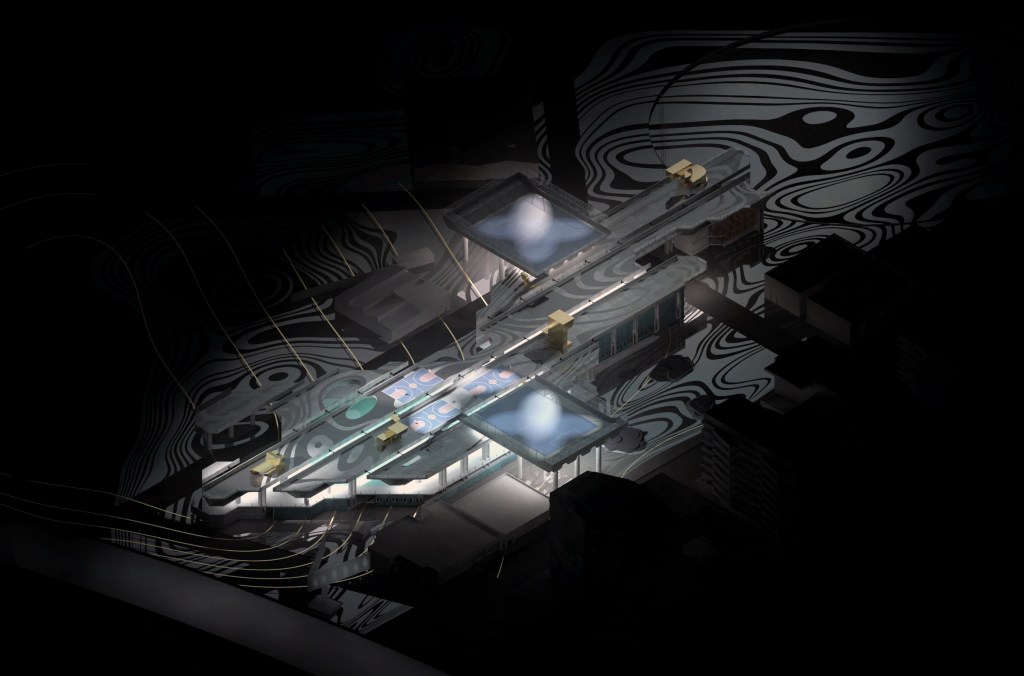
The building itself gives very little away. When viewed from the future Arden Development, it appears as a plateau, with a solid infill of concrete only punctuated by the street passing below.
As you move closer, the building begins to slowly reveal more of itself. From the oval, there is a hint of steam being released from the cavernous openings above the structure, and a glinting brass seating pavilion and bar can be seen just beyond.

Dear Pool,
I still remember visiting you last summer. The beating sun had baked the tarmac, making it feel almost liquid underfoot. As I turned the corner around Arden Street, I remember darting from one patch of shade to the next. The small benches formed a series of ponds to swim through before finally reaching the cool steps calling me inside.
Formally, the building draws upon the industrial nature of the site and an analysis of the existing suburban pool typologies in Melbourne. By borrowing a classification system for pools, I chose a HydroMimetic Pool as a way of responding to the industrial surroundings. The key features of the HydroMimetic Pool include forms and compositional devices that mimic the surrounding environment.
These classifications were originally intended for suburban and natural settings; however, I was interested in the results when used as a design tool in a more urban and industrial environment.
The entry from Arden Street begins to break down the looming mass, and recognisable elements start to appear: steps, a handrail, a neon sign. The copper-stained concrete resembles both the corrugated backyard fence used to guard a family pool and the industrial roofs of the surrounding buildings.
The roof of the project forms a strip of public recreation facilities with a mixing and layering of sports fields. The brass pavilions come into focus and house various amenities and seating platforms for the spectators of the games. The roof park connects the existing oval with the freeway, acting as an elevated park and sports field.
From the rooftop, you gain your first glimpse of the pool inside, with a public stair puncturing the pool facilities below, allowing a view of the pool scene beyond.
Within the pool, the enormous scale of the freeway structure can be truly felt. The cavernous space is defined by the relentless grid of columns that support the structure above. The hazard-tiled pillars make no attempt to avoid colliding with the pool below.
The water of the pool covers the majority of the floor, broken only by thin catwalks that delineate the different program pools. The lanes of the lap pool are defined by the neon strip lighting overhead, orienting themselves to the freeway profiles.
The brass changeroom marks the edge of the space, with a public shower located just before it, providing a place to rinse off before and after your swim.
The open changerooms allow water to pass freely from the shower and the gaps in the roof above. The metal takes on the stain of the water and slowly acquires the same qualities as the pool. The runoff water in the changeroom and across the surface of the floor is channelled into the brass drains that meander across the surface, eventually returning to the pool. The position of the drains directly corresponds to the contour lines of the floodplain on the ground below, referencing the original pattern that carved the building.
Over the northern edge of the pool, several large openings slice through the structure above, allowing light to pass through to the pool below, and creating moments of intimacy within the cavity. A steam room and sauna occupy these spaces, offering a sheltered view across the pool and to North Melbourne beyond.
The project attempts to respond to the infrastructural necessity of the new development in the Arden precinct while still referencing the industrial scale and environmental preconditions of the site.


Dear Pool,
I passed you just the other day on my way from the Metro station. I remember how large and elongated you were, but upon reflection, with the rapidly changing skyline of the area, you seem just about right. Which reminds me, I have to drop by for a swim again soon.
Yours sincerely,
The Swimmer

 thexhausted.com