THE RUB
RMIT University Master of Architecture Graduate Project 2019
Supervisor: Michael Spooner

Introduction:
This project originally centred on two main concerns: preservation and progress. Over time, it became increasingly clear that while my interest straddles these two conditions, it is specifically focused on their intersection—where both can coexist simultaneously—and explores the potential found in this overlap.
The Myth:
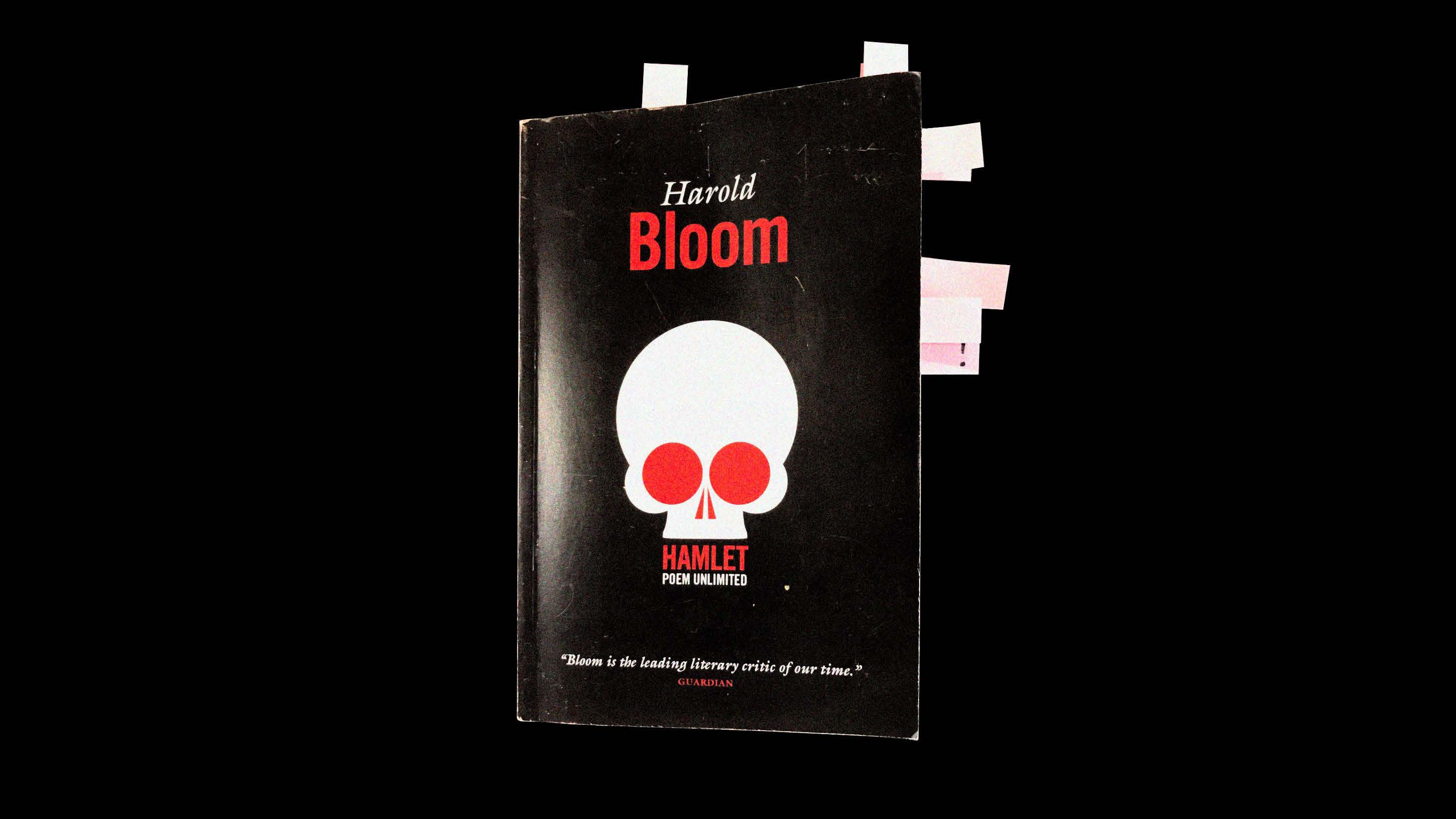
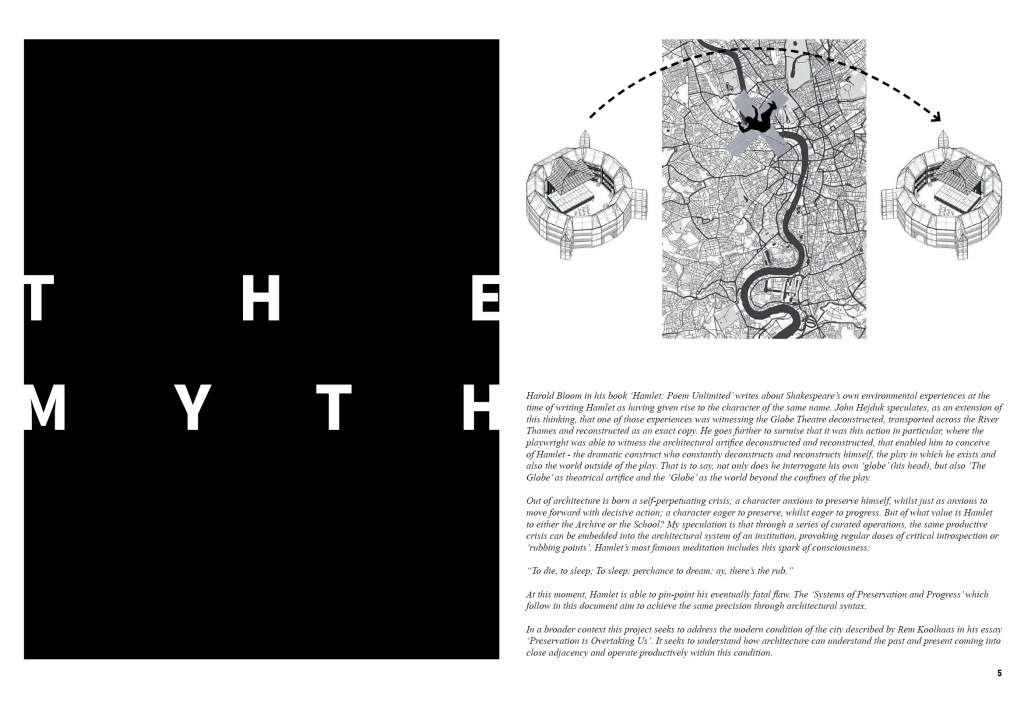
In his book Hamlet: Poem Unlimited, Harold Bloom discusses how Shakespeare’s environmental experiences during the time of writing Hamlet influenced the creation of the character. Bloom suggests that these experiences played a significant role in shaping Hamlet’s complex persona.
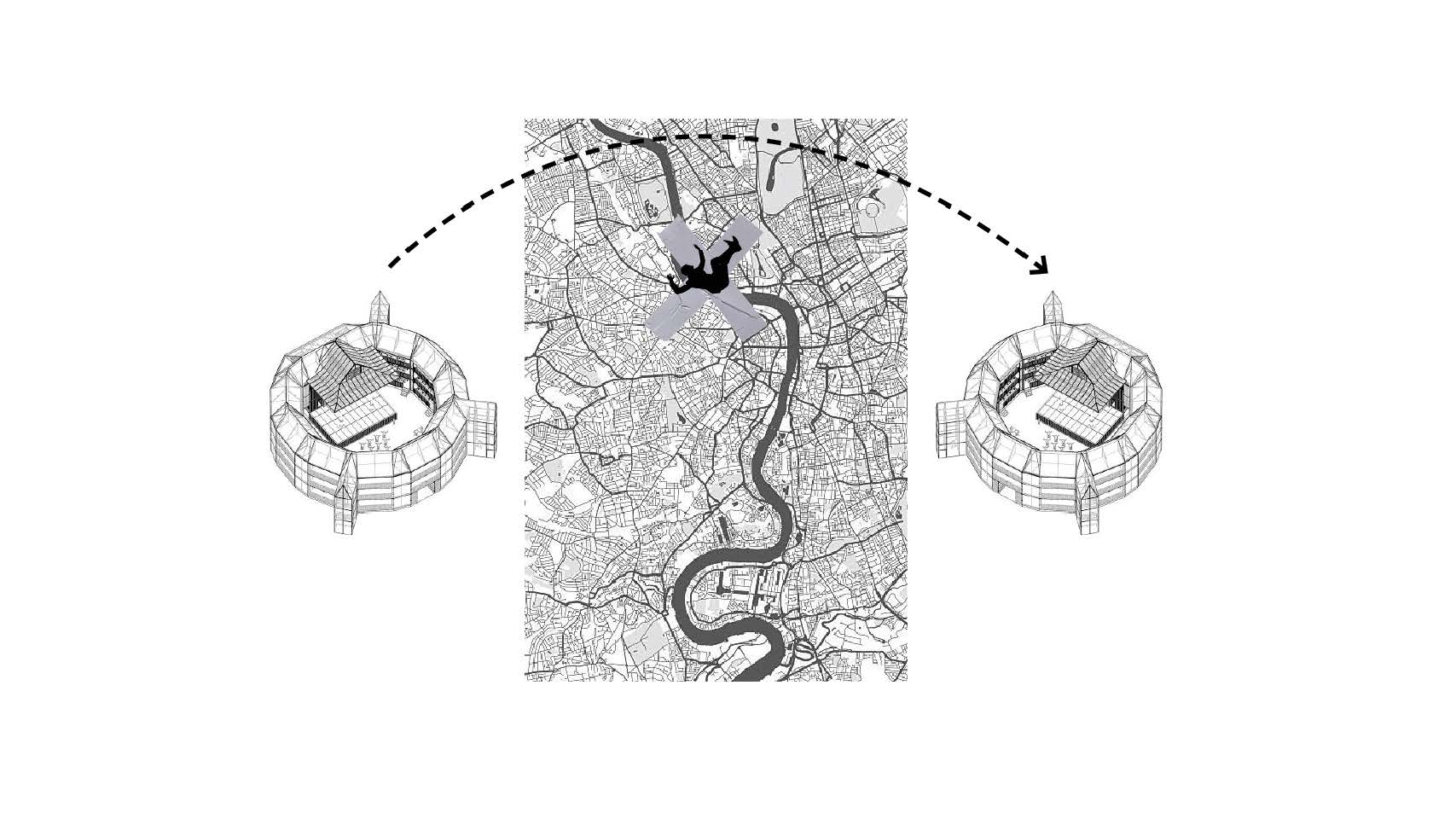
John Hejduk extends this notion by speculating that one of Shakespeare’s significant experiences was witnessing the Globe Theatre being deconstructed, transported across the River Thames, and then reconstructed as an exact replica. Hejduk suggests that this process of deconstruction and reconstruction profoundly influenced Shakespeare’s creation of Hamlet, a character who continually deconstructs and reconstructs himself, the play in which he exists, and the world beyond it. Hamlet’s introspection not only involves examining his own ‘globe’ (his mind) but also critiques ‘The Globe’ as a theatre and ‘The Globe’ as the world outside the play.

Architecture gives rise to a self-perpetuating crisis: a character torn between the desire to preserve himself and the need to advance with decisive action. But what is Hamlet’s value to either the Archive or the School? I speculate that by integrating a series of curated operations, the same productive crisis can be embedded within the architectural systems of an institution. This approach could stimulate ongoing critical introspection and reflection.
Castle Kronborg: Calamitous Grounds.
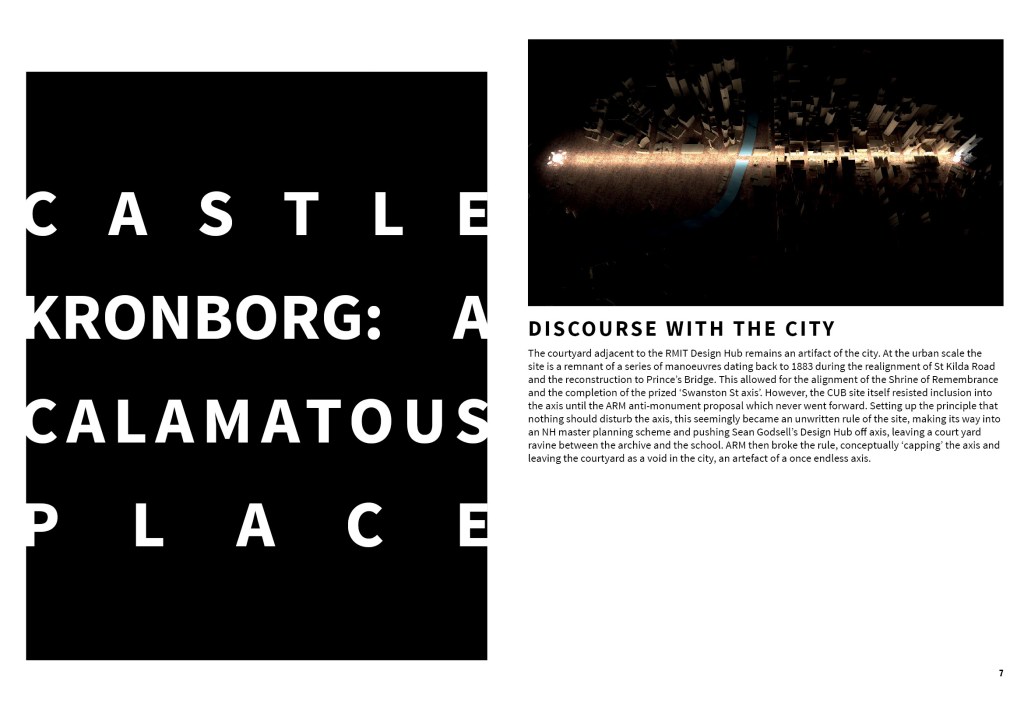
The site, fittingly, is both a component of the university’s broader discursive conversation and an artefact of the city. At the urban scale, it represents a remnant of historical changes dating back to 1883, including the realignment of St Kilda Road and the reconstruction of Prince’s Bridge, which reinforced the significant Swanston axis. Following ARM’s anti-monument proposal and NH’s subsequent master plan, Godsell’s design hub was compelled to align with the axis, creating a courtyard ravine between it and the archive. ARM later challenged this rule by conceptually capping the axis.

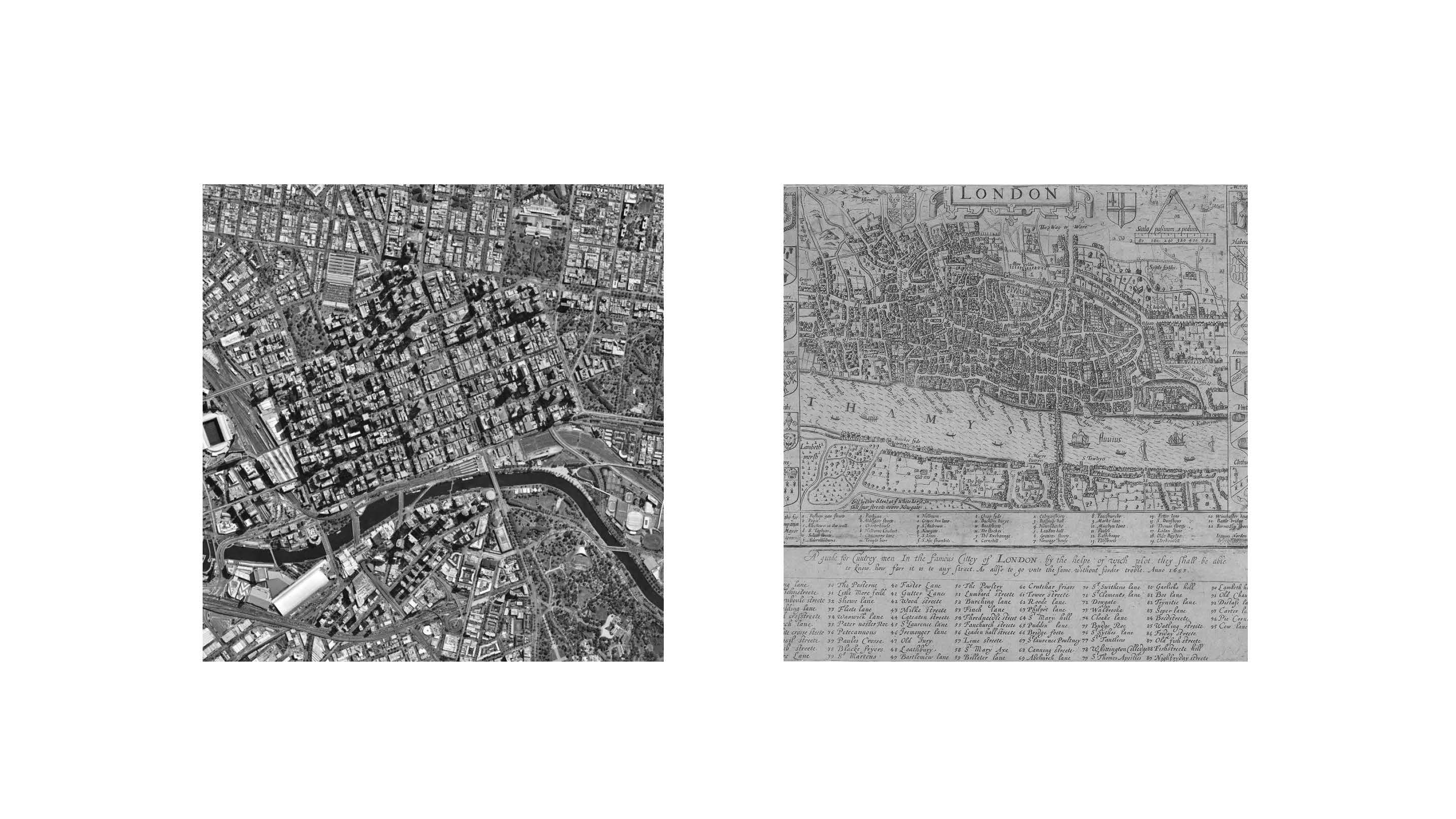

Building on the schism and the dichotomous relationship between the Design Hub and the adjacent Design Archives, my initial strategy is to merge the realms of learning, discovery, and progress with those of collection, curation, and preservation.
By introducing an operation that slices the original school building and extends it across the site, both the design archives and the courtyard artefact are enveloped and explicitly claimed by the school. This operation effectively entombs them as objects of the archive, integrating them into the school’s own narrative.


This operation also aims to re-enact the transport of the Globe Theatre by reimagining the courtyard—the space between the buildings—as the transformative waters of the River Thames. Unlike the Globe Theatre, which was entirely rebuilt, this project seeks only a partial reconstruction. It suspends itself over the waters, partially transferred, necessitating a constant negotiation or ‘crossing’ between the river and its two banks via an archive bridge.

At a smaller scale, the site contributes to a broader dialogue along the RMIT section of Swanston St, which challenges the architectural perspectives of the institution. My proposal extends this conversation by questioning whether it can be sustained within a new, unified entity that straddles the axis.
‘…perchance to dream’:
Suspended over the river, the architectural construct, like Hamlet, can be actively introspective.
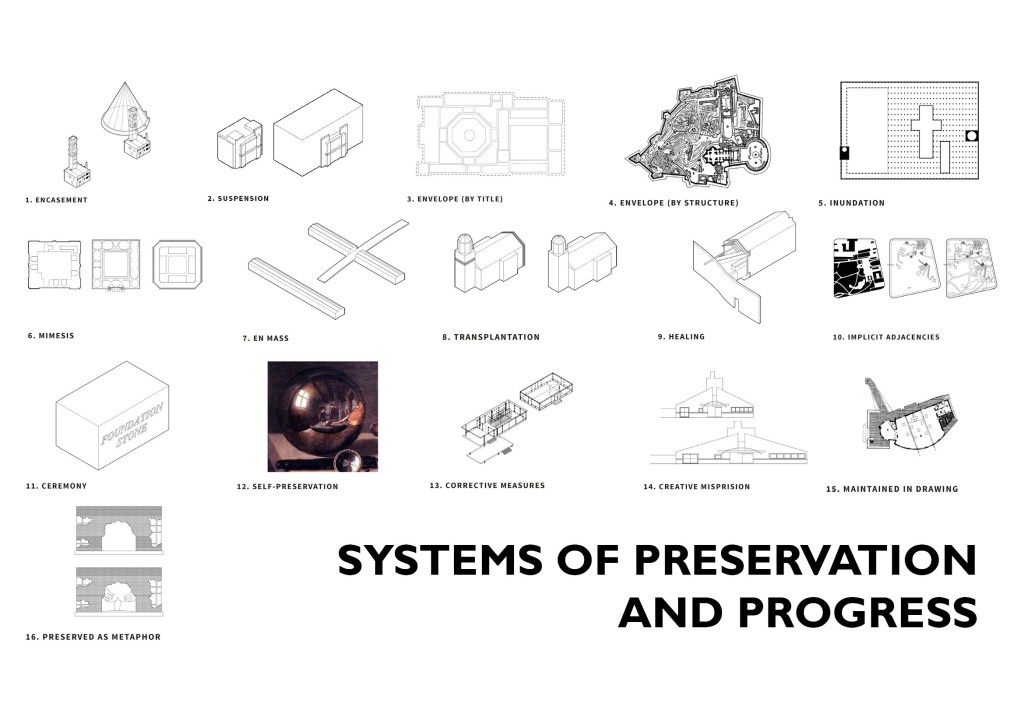
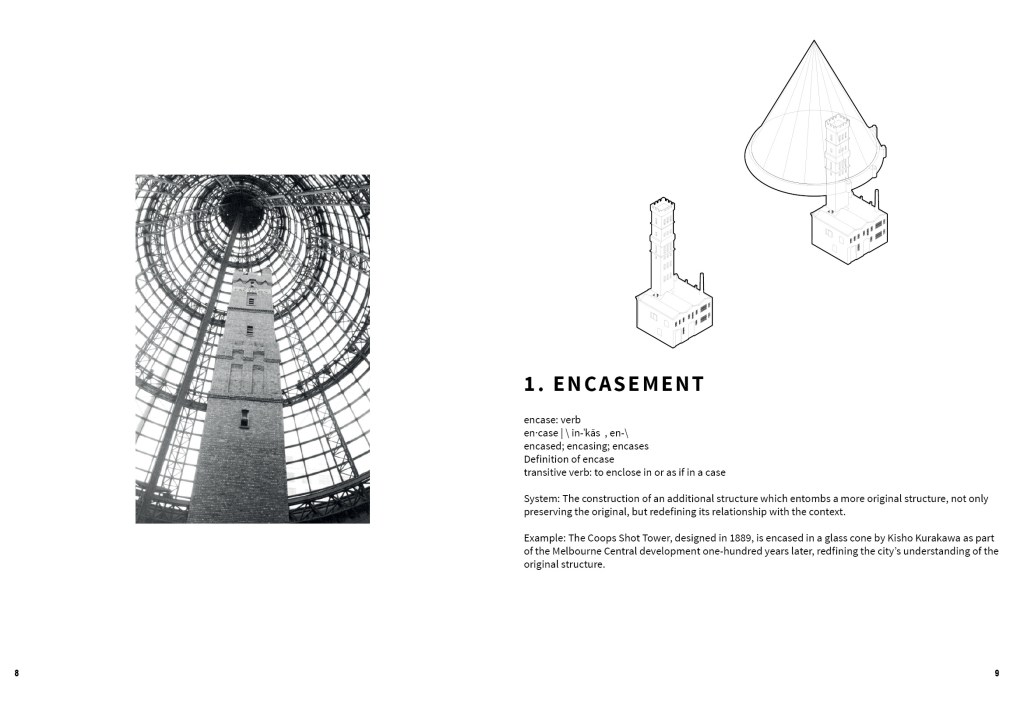
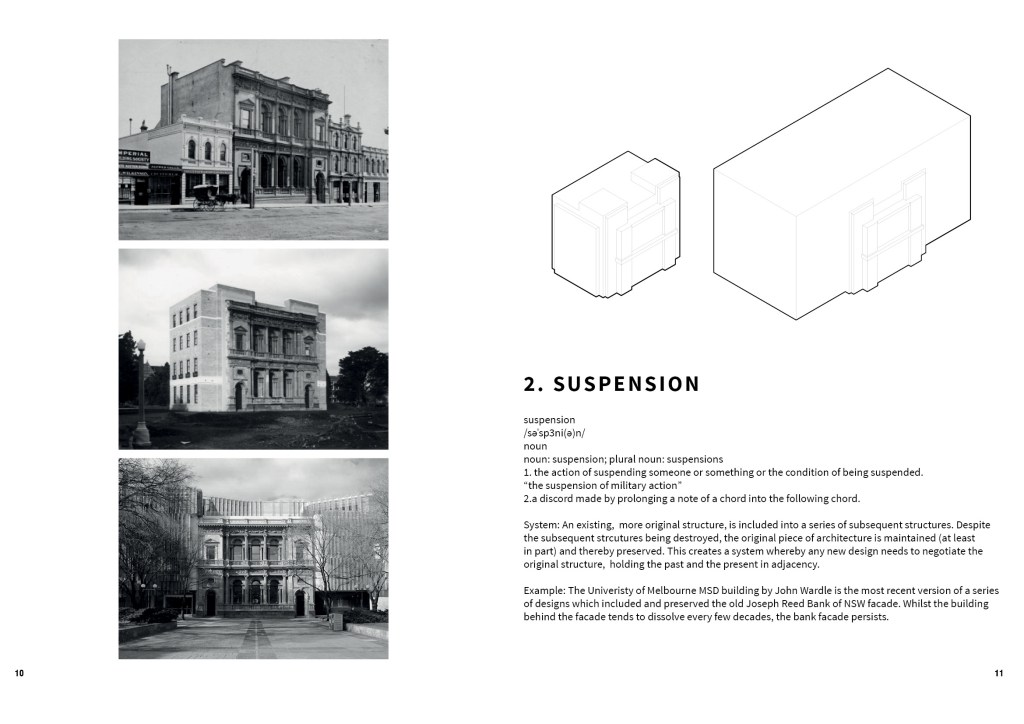
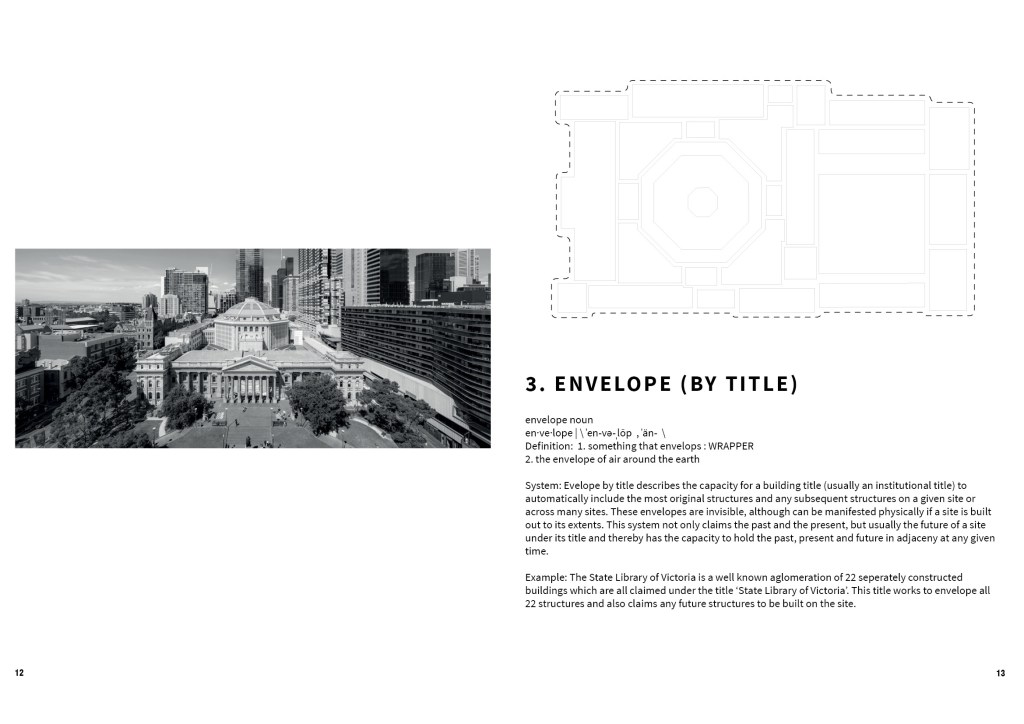
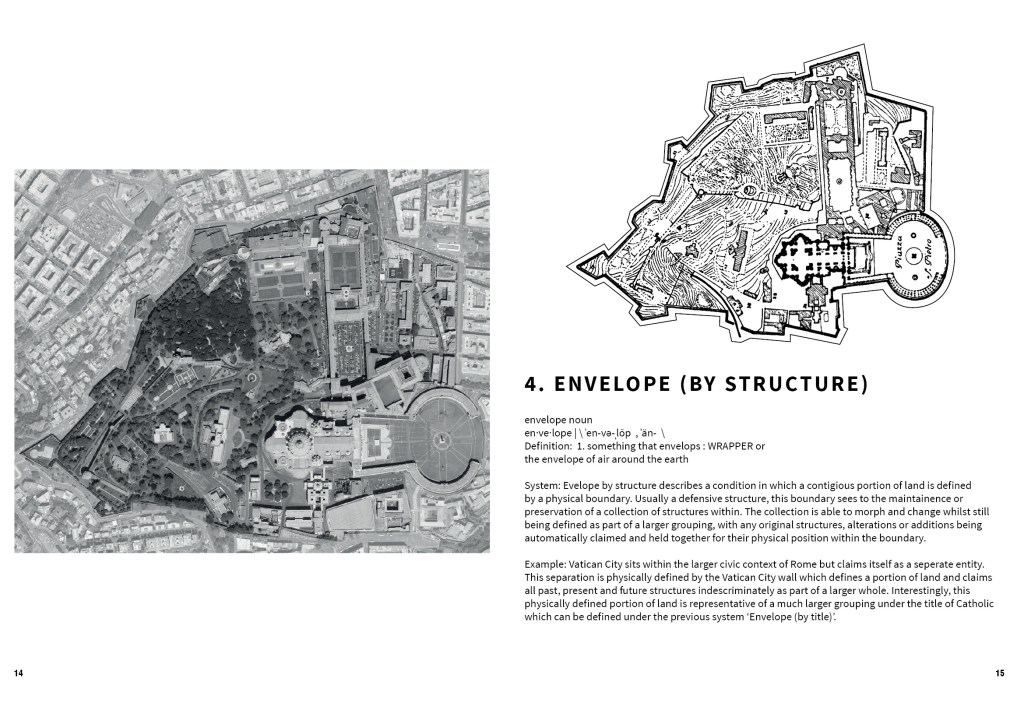

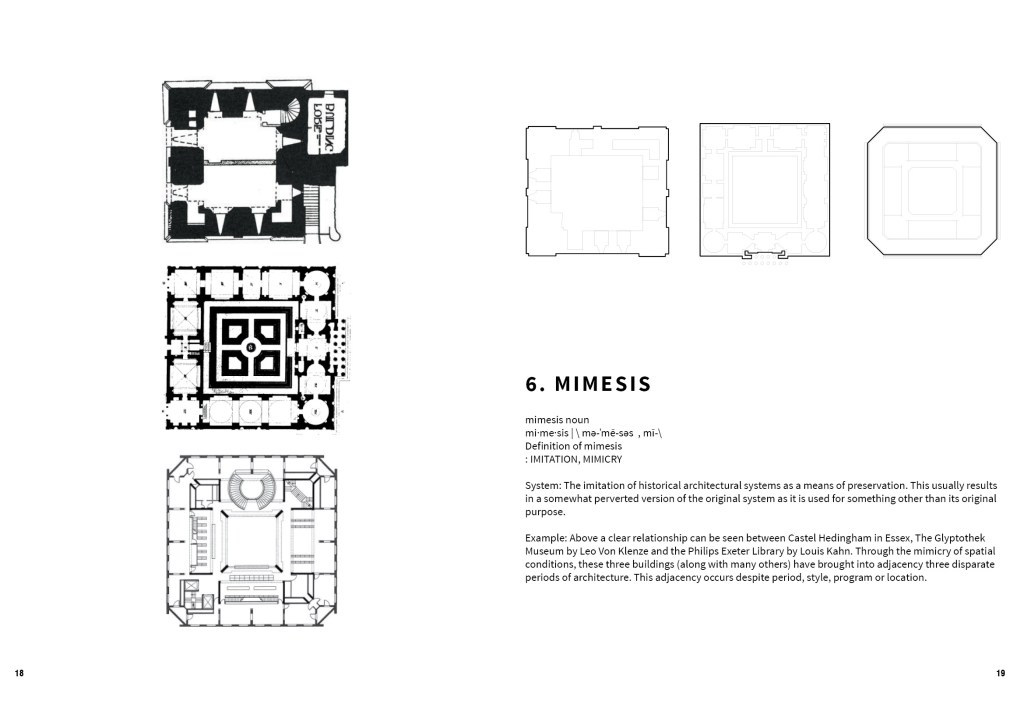

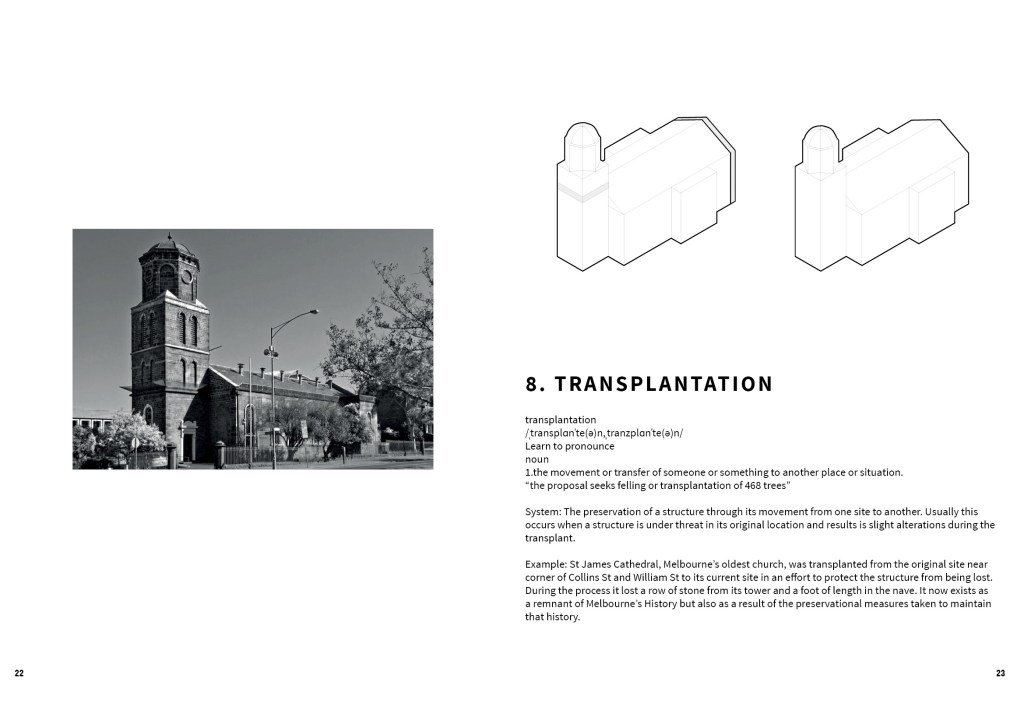


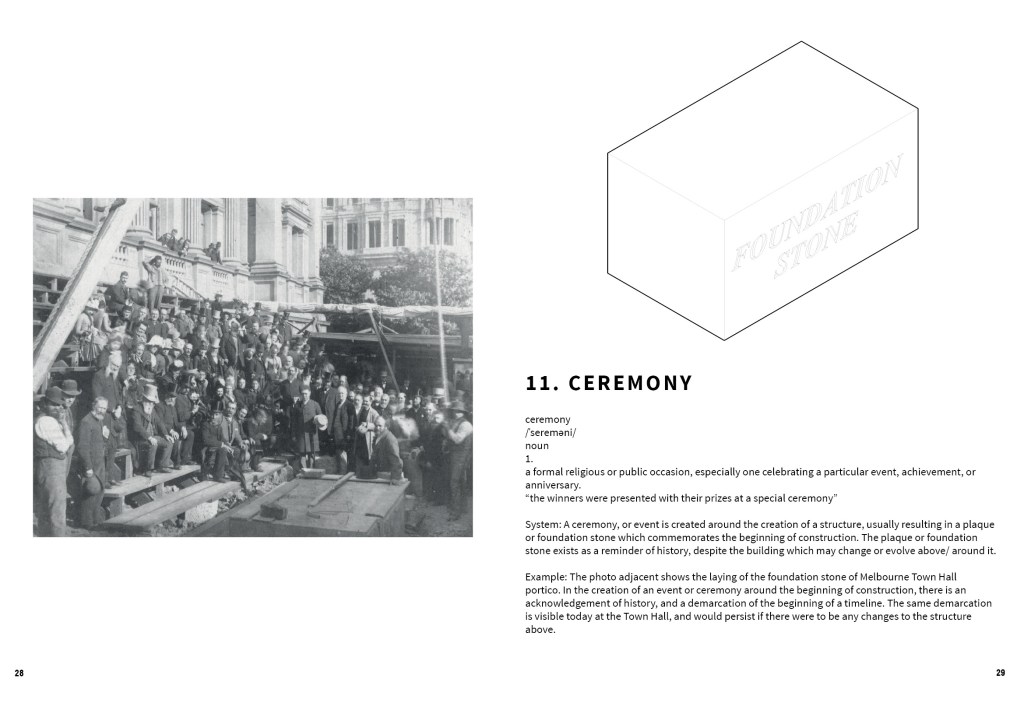
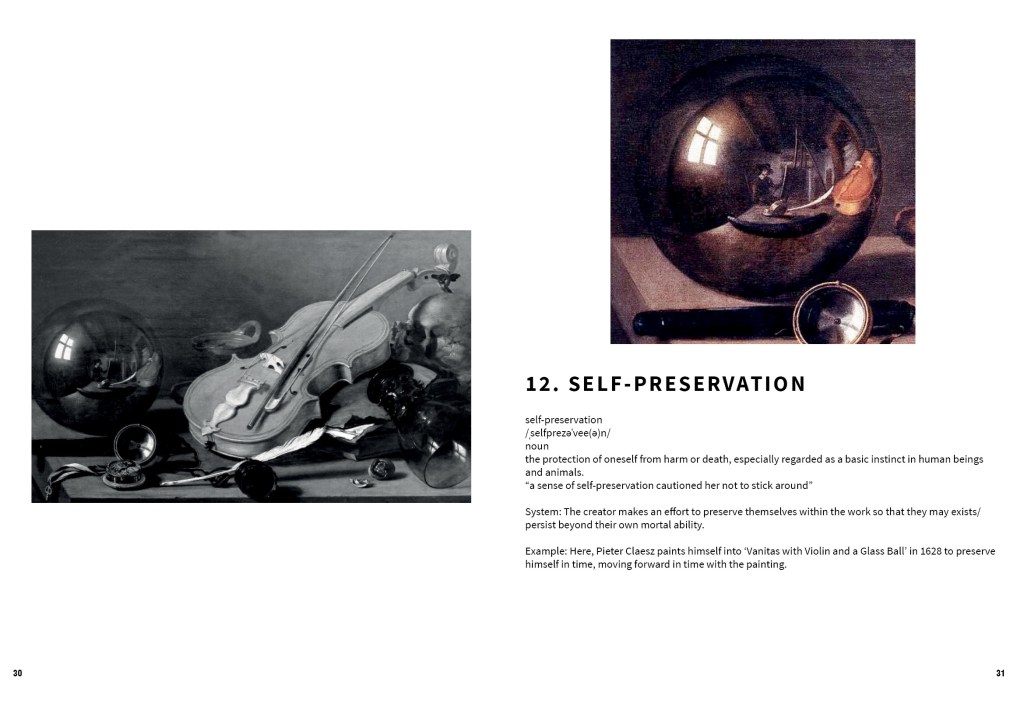


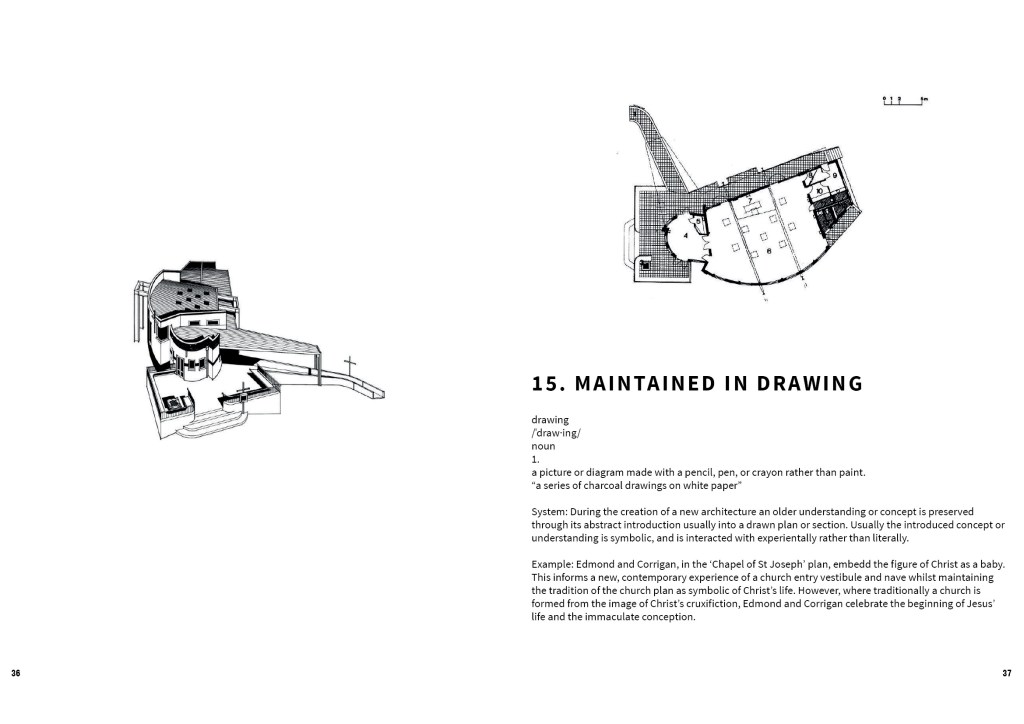

By bringing together a range of histories—from existing conditions to the nebulous aspirations of an architect—a condition is created that juxtaposes these specific histories along with their broader implications. Sixteen ‘systems of preservation and progress’ (as detailed in the project footnotes above) serve as the architectural methods for establishing this condition.

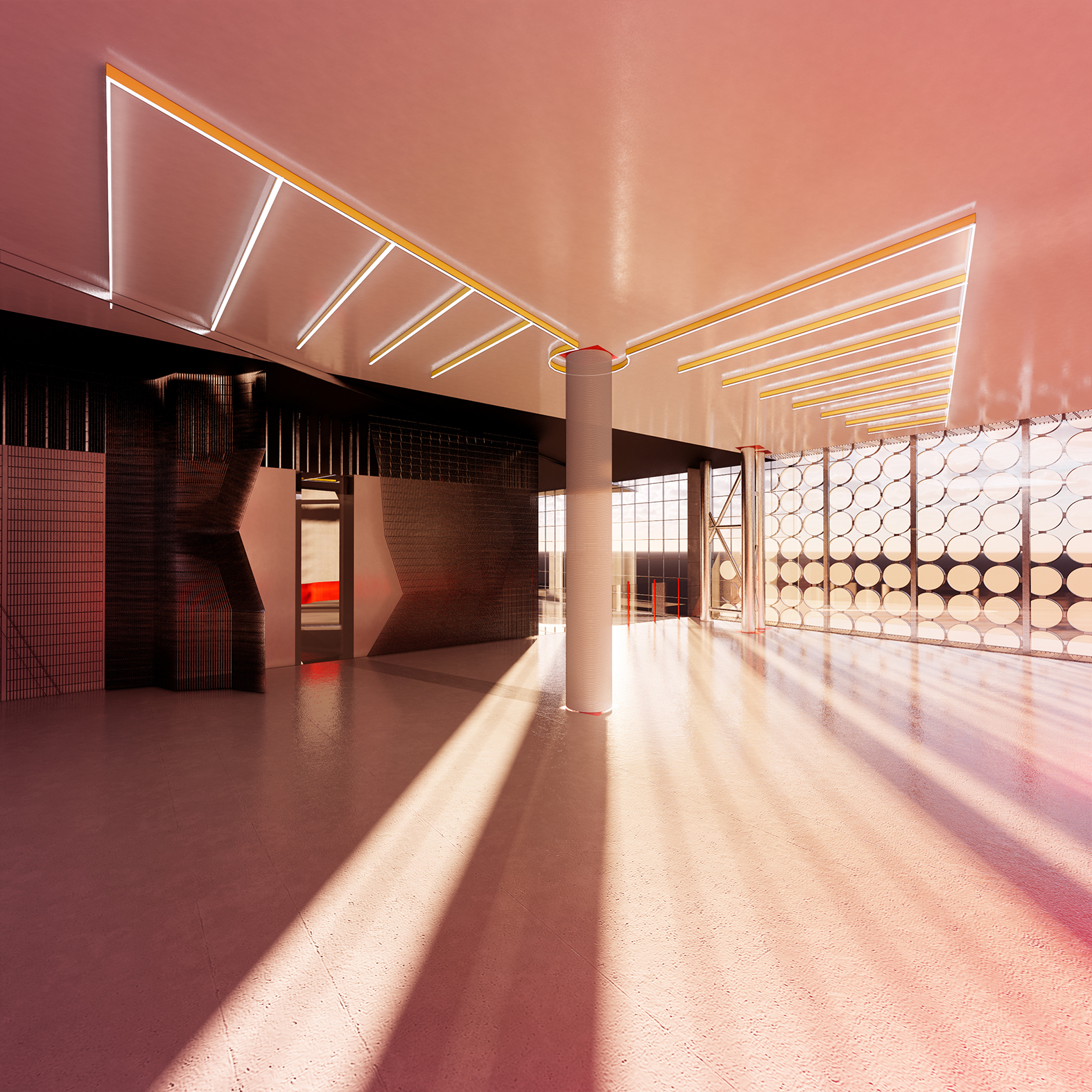
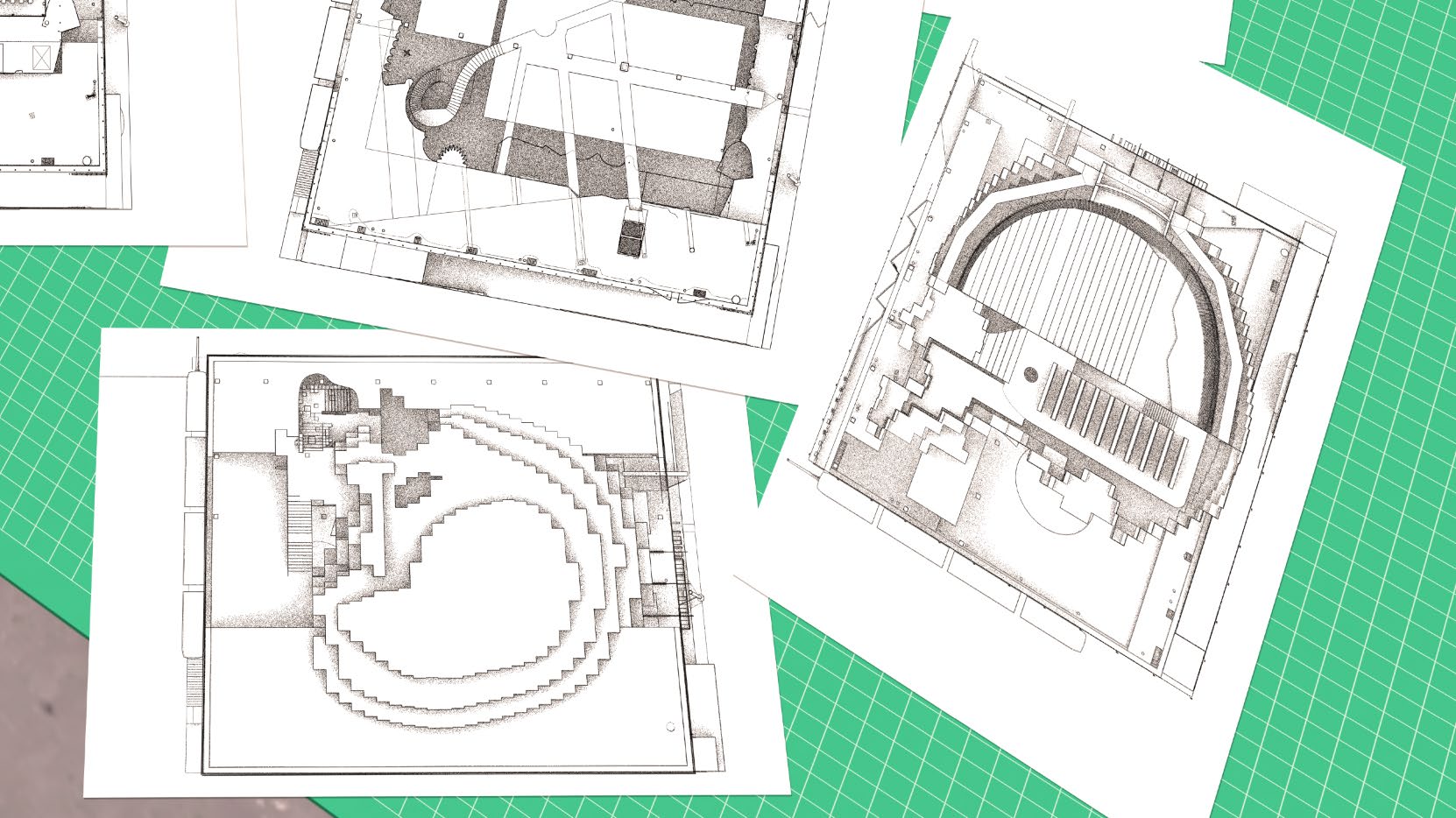
This can be observed in the space where the Design Hub’s foyer once existed. Following Sean’s vision, the height and length of Michelangelo’s Laurentian Library are reinstated as the new ceiling datum for an exhibition space. Featured in the exhibition is the foyer of Building 8, represented as a floor plan composed of ceiling lights, suspended against the ceiling plan of the Laurentian Library, which is inlaid into the floor of the new gallery space. Their adjacency begins to resolve through the actual tectonic realisation of the elements depicted in the plan. This representation not only highlights the previous foyer of the architecture school but also evokes the proclamation of the basement wall, scrawled on a tram by Corrigan and recited by Godsell: “Mother Knows.”


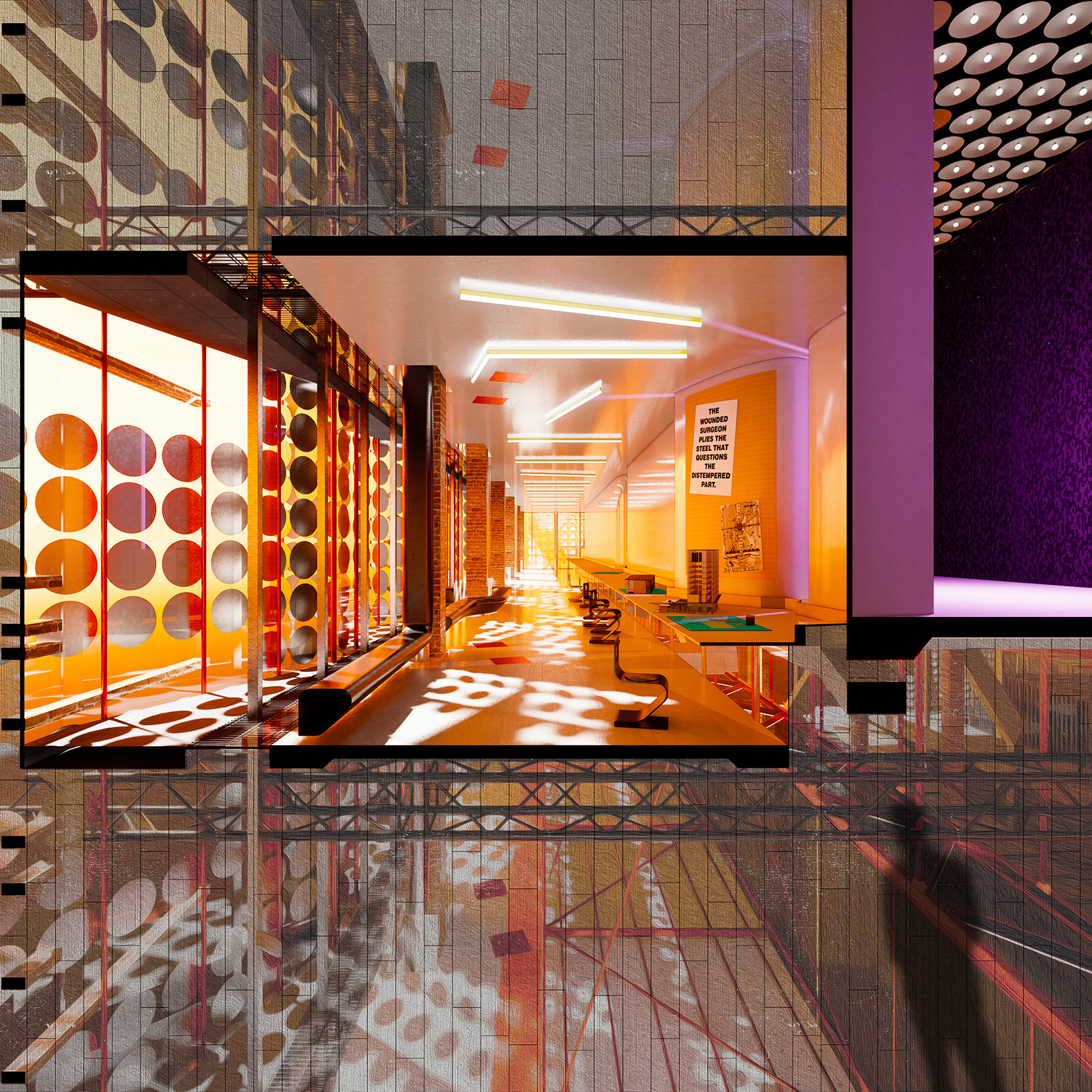
The design hub stair, which extends from the foyer level to the Level 1 basement in a continuous line, remains intact despite the rest of the building being shifted across.
As a primary entry point from street level, the stair’s elongated proportions are exposed not only to those using it but also to those nearby. With nothing left but the floor and the web forge, the experience of entering is shaped entirely by one of the building’s defining materials.


The halved courtyard steps realign the Victoria St entry with the axis, establishing a procession leading to the monument, now missing its heads. This creates a sectional relationship between the two memorials on the site, revealing a condition that juxtaposes well-known representations of the school’s future and past.
Against this red and black backdrop, a robot dances on rails.

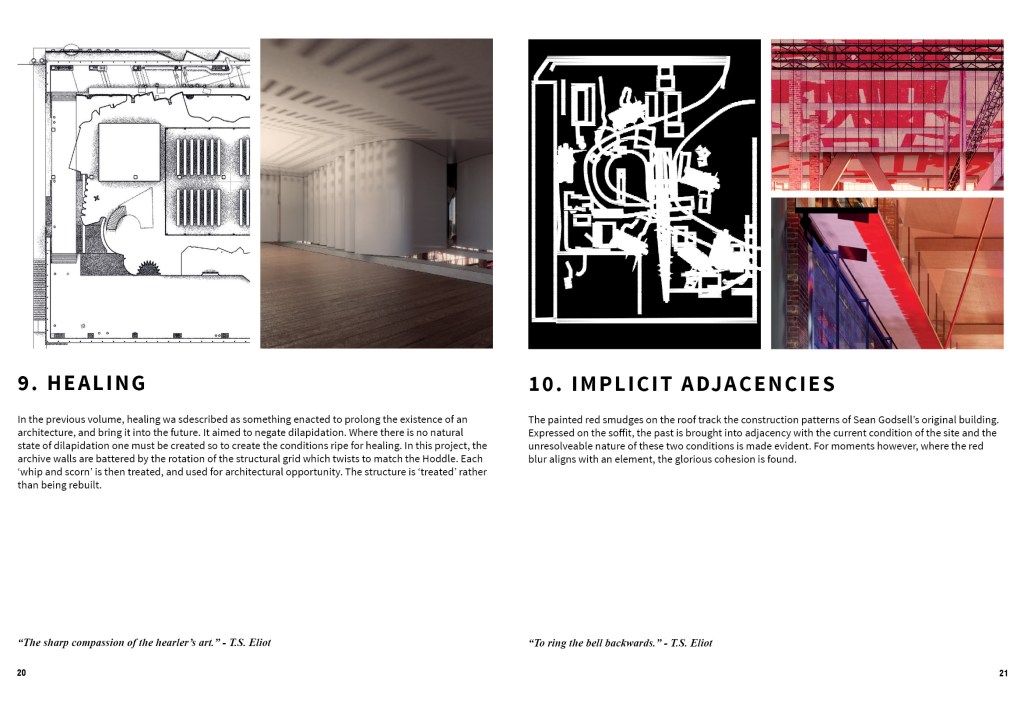
The soffit bridging above is adorned with blurry red lines that echo the construction patterns of Godsell’s original design, underscoring the unresolved tension between the past and the present. This visual element raises questions of meaning and intent, which are only vaguely addressed when the red blur occasionally aligns with remnants of Sean’s original work.
The remaining portion of the existing design hub structure, which did not shift across the river, is left precariously positioned on a flawed point that aims to resolve the entire building’s configuration. In a lecture following the building’s completion, Godsell mentioned that the original concept included spheres rather than discs. By taking Sean’s vision as a more accurate representation, the building’s set-out point is reinterpreted as its truest form, evolving into a string of pearls that reflects Swanston St back at itself.

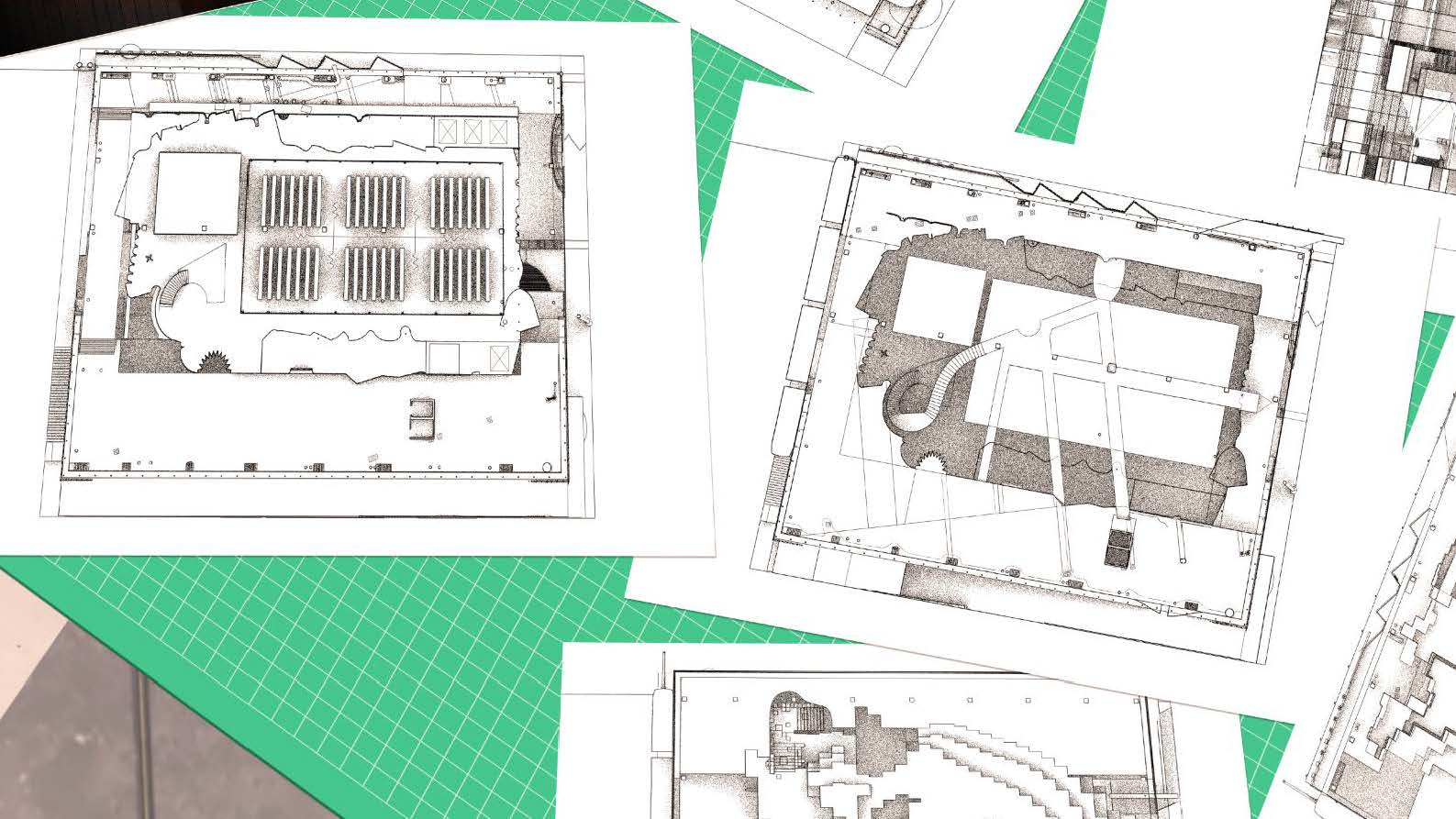
Absorbing the city, the column grid of the building is realigned at 24.57 degrees to align with the Hoddle grid. This misalignment of the columns is manifested as a literal scar on the floor and ceiling of the new teaching spaces but is most apparent in the central archive space.
In Hamlet, Ophelia’s descent into madness acts as a literal measuring stick for the state of Denmark. Similarly, within the building, the central archive storage reflects this notion, with each shifted column creating a type of wound on the outer skin.
The original archive building now stands encased, first by the operation of crossing the river and then preserved within glass, reinforcing its status as a precious original. Already absorbed into the larger Design Hub box, the original archive building is now contained within its own ‘glass cabinet,’ making it difficult to discern whether it is merely a symbolic remnant of a past function or still an active component of the archive. Its relationship with its context becomes ambiguous, transforming it into a building encased within another encasement—a play within a play, if you will.
 Along Swanston St, the façade is largely stripped of discs, with an attempt at restoration achieved through the addition of a single large disc, referencing the sequence of bay windows that once characterised the city campus.
At the other end of the façade, there is a material shift back to CUB brick, while striving to maintain a sense of porosity. This historical material contrasts with the modern aspirations of the building’s skin, resulting in a façade that appears to be in a state of decay—perhaps another metaphorical falling wall.
But why? Programmatically, the building aims to embody the ‘radical school’—aspiring to be a system or provocation through which pedagogical evolution can occur. More broadly, the project seeks to enhance architecture’s capacity not only to provoke but also to facilitate change. It explores how architecture can function within an increasingly preserved environment and investigates methods by which this can be achieved.
‘…perchance to dream’:
It seeks to engage with what T.S. Eliot described as ‘the loud lament of the disconsolate chimera,’ where ‘time present and time past are perhaps present in time future.’
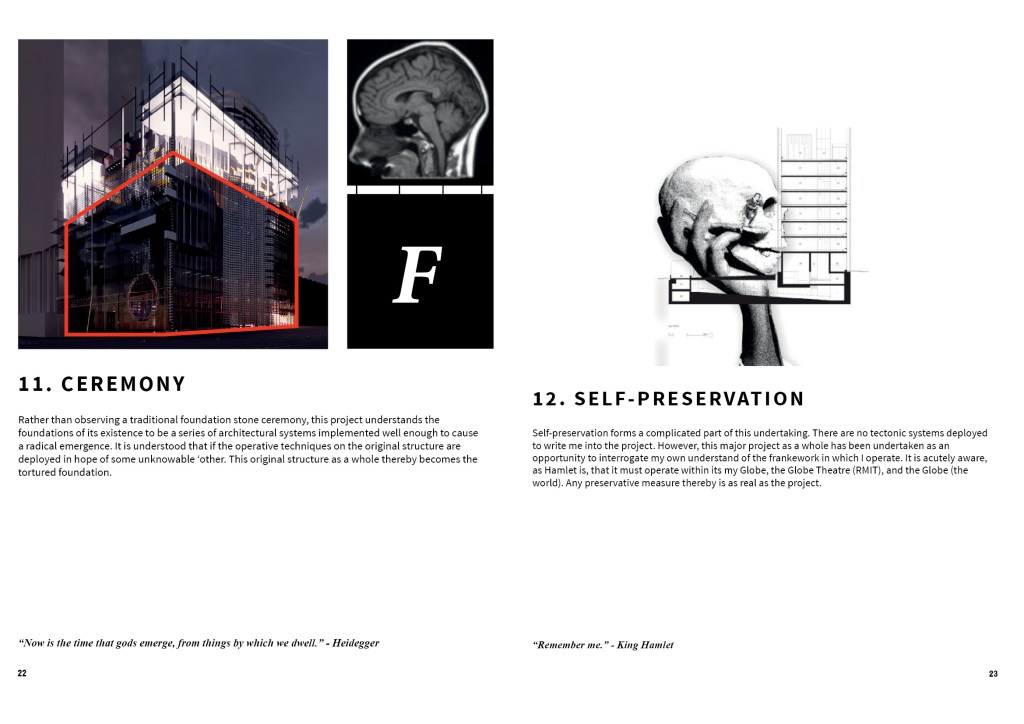
This lament resonates in the object that sits atop everything else. Self-assured yet perhaps knowing less than any other part of the project, it represents a logical culmination—a type of telos or capstone for the project. In Bloom’s terms, it could be seen as Hamlet’s necessary annihilation. T.S. Eliot captures a similar sense of necessity in his poem Four Quartets, where he speaks of an ascension ‘costing no less than everything.’



In my own terms it represents that next thing ex renovatio. It queries, in its abysmal depth what could be (perchance there should be a dream beyond what is) and what we now know. It understands that all this ‘stuff’, all of these operations are in hope of some ultimate emergence, albeit undefinable until somehow as apparition it rises.
It tries to answer every question with satisfactory precision but answers nothing quite well enough. It is an almost cloud, made almost solid, of almost stone.
It is perhaps Yorick’s skull, with his brain still encased.
And it is my exit to a world beyond the wall, through the quatrefoil and out the doors of the Laurentian Library, released by Michelangelo or Peter or Sean or Shakespeare. It is but a ball of questions. Perhaps in that, there is an answer enough to keep asking.




 thexhausted.com